Kitchen note
Ancient Chinese Architecture and its Hidden Meanings
From grand imperial palaces and sacred temples to modest rural homes, traditional Chinese architecture reflects the heritage of a civilization that has developed over roughly 5,000 years. The architectural traditions passed down through successive Chinese dynasties can still be seen across the country, appearing in historic cities, decorative windows, private residences, gardens, and monumental buildings.
Julian Everly
Cook
Bench note
The full story and useful tips are below.
Shelf
Plant kitchen
From grand imperial palaces and sacred temples to modest rural homes, traditional Chinese architecture reflects the heritage of a civilization that has developed over roughly 5,000 years. The architectural traditions passed down through successive Chinese dynasties can still be seen across the country, appearing in historic cities, decorative windows, private residences, gardens, and monumental buildings.
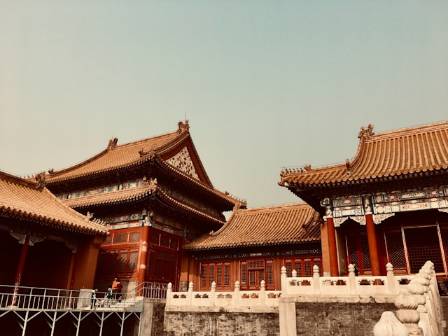
In traditional Chinese architecture, windows and doorways often function like carefully composed picture frames, offering changing views of the natural world throughout the year. A passage within the Forbidden City, for example, can frame blooming apricot trees in spring, creating a harmonious scene in which red walls, green roof tiles, and delicate white flowers complement one another.
These structures are more than impressive works of construction. They can also be understood as three-dimensional expressions of traditional Chinese philosophy, conveying concepts associated with Confucianism, Buddhism, and Taoism through architectural details. Curving eaves, elaborate bracket systems, carved wooden beams, carefully positioned stones, and balanced layouts all contribute to an architectural language characterized by creativity, grandeur, adaptability, and strength.
Flying Eaves and Curved Rooflines
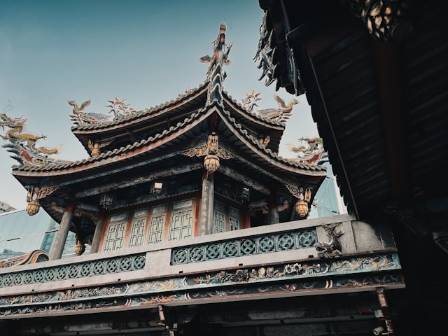
One of the most recognizable features of traditional Chinese buildings is the ornate roof, particularly its sweeping lines and raised corners. These upward-curving edges are known as flying eaves, giving buildings an appearance of elegance and lightness, almost as though the structure is being gently lifted toward the sky.
Their beauty is not purely decorative. The shape of the eaves also serves practical purposes by helping rainwater flow away from the building and providing a degree of protection against lightning. In the Forbidden City in Beijing, beautifully painted flying eaves and intricate bracket systems can be seen on many of the traditional palace roofs.
A central concept in much of Eastern philosophy is balance, which emphasizes the relationship between forces that may appear opposite yet complement one another. This principle strongly influenced traditional Chinese architecture. It can be observed in the symmetry of buildings, the interaction of different geometric forms, the careful use of color, and the constant relationship between architecture and the surrounding natural environment.
The Symbolism of Yellow
In traditional Chinese culture, yellow is associated with earth, one of the five fundamental elements. Earth occupies the central position and is regarded as the foundation from which other things emerge.
The deepest and most prestigious shades of yellow became closely associated with imperial authority and the royal household. This symbolism can be clearly observed in the Forbidden City, where the roofs of many palace buildings are covered with golden-yellow glazed tiles. The distinctive color communicates the elevated status and exceptional authority of the imperial family.
Symmetrical Patterns
The Confucian concept of the Golden Mean is an important principle within traditional Chinese culture. It emphasizes moderation, balance, and avoiding extremes in human behavior. In architecture, this philosophy is often expressed through carefully arranged symmetry between the central structure and its supporting or secondary elements.
Large architectural complexes provide especially clear examples of this approach. In the Forbidden City, buildings and courtyards are organized around a strong north-south central axis. This axis serves as the structural backbone of the entire complex, creating a sense of order, balance, and visual harmony.
The theory of the five elements also influenced the way colors were used in traditional architecture. Fire is associated with red and is believed to generate earth, while earth represents nourishment and stability. For this reason, red became an important architectural color, appearing on palace doors, windows, and walls as a symbolic expression of prosperity, protection, and the well-being of the people and land within.
Combinations of Squares and Circles
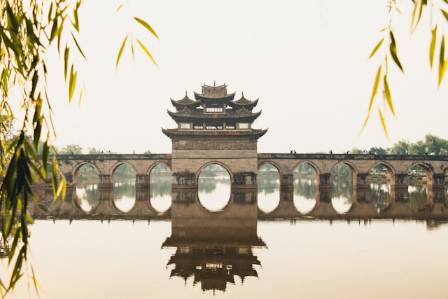
Ancient Chinese thought traditionally associated Heaven with circular forms and Earth with square ones. As a result, the combination of round and square shapes became an architectural expression of the relationship and harmony between Heaven and Earth.
Buildings and landscapes designed according to these principles were believed to create an environment conducive to peace, balance, and well-being for the people living within them.
Chinese gardens especially demonstrate this philosophy. Garden designers sought to create landscapes that appeared natural and spontaneous while actually being carefully planned by human hands. Their goal was to establish a visual relationship between Heaven, Earth, and humanity.
Traditional Chinese buildings generally have a fundamentally rectangular or square structure. Their sweeping roofs, however, introduce curved lines at the highest point of the building. Rounded arches are also commonly incorporated into doors and windows, creating a subtle contrast between angular foundations and softer circular elements.
Architecture South of the Yangtze River
Buildings in the regions south of the Yangtze River often feature the characteristic curved flying-eave roof combined with blue-gray tiles. Together with whitewashed walls, these elements create the distinctive blue-and-white appearance associated with many traditional settlements in southern China.
The upward-curving roofs give these buildings an elegant and almost weightless appearance, as though they were shaped by the surrounding natural landscape. At the same time, the roof design has important practical advantages, helping rainwater drain efficiently and providing some protection from lightning.
Harmony of Colors
Traditional Chinese culture recognizes five primary colors that correspond to the five elements and the five cardinal directions. Maintaining harmony among these elements was believed to establish balance throughout the world.
Green is connected with wood and the east, while red represents fire and the south. White corresponds to metal and the west, black represents water and the north, and yellow is associated with earth and the central position.
The Forbidden City offers an excellent example of this symbolic color system. Its elaborate bracket structures and architectural decorations feature clouds, dragons, flowers, and other auspicious motifs, while carefully selected colors reinforce ideas of status, good fortune, and harmony.
Imperial architecture in northern China is particularly recognizable for its combination of vivid red walls and golden-yellow roof tiles, often enhanced with blue and green decorative details. By contrast, many gardens and temples in southern China favor white walls, dark columns, and blue-gray roofs, creating a more subdued and tranquil atmosphere.
The Horse Head Wall
The Horse Head Wall, sometimes referred to as the Wall of Fire, is a distinctive feature of traditional Huizhou architecture. Unlike ordinary walls, it extends above the roofline and descends through a series of stepped levels.
The height and length of the ridges and eaves can vary from one residence to another, producing a layered visual rhythm. These walls are aesthetically distinctive, but their purpose was also practical. They helped prevent fires from spreading between neighboring buildings and offered protection from strong winds.
Connection with Nature
Traditional Chinese architecture has always placed considerable importance on the relationship between humanity and the natural world. This idea can be found in Confucian thought, including the concept of harmony between Heaven and Earth, as well as in Taoist philosophy, which emphasizes the unity of Heaven, Earth, humanity, and all living things.
Architecture therefore does not simply occupy a landscape. Ideally, it becomes part of that landscape.
Traditional houses in Huizhou provide a particularly beautiful example. White walls and blue-gray roofs are often surrounded by mountains, fields, rivers, and seasonal vegetation. When golden rapeseed flowers bloom around these villages, the contrast between the architecture and countryside creates an exceptionally harmonious scene.
Architecture as an Expression of Nature
For thousands of years, Chinese culture has celebrated the country’s landscapes through architecture as well as poetry, painting, and written art. Nature was not regarded merely as something to observe from a distance; it was an essential part of human existence and cultural expression.
This close relationship between people, nature, and Heaven has influenced Chinese architecture throughout history. Buildings, gardens, courtyards, mountains, water, plants, and decorative elements are often arranged so that no single feature feels completely separate from its surroundings.
The result is an architectural tradition that combines practical construction with philosophical meaning. Traditional Chinese structures are designed not only to provide shelter or demonstrate power, but also to create environments that encourage balance, beauty, reflection, and tranquility.
The Three Elements of Traditional Architecture
The pavilions of Beijing’s Summer Palace demonstrate three fundamental components commonly found in traditional Chinese architecture: the elevated foundation platform, the timber structural frame, and the decorative roof.
The substantial platform provides a stable base for the structure, while the wooden framework forms the main body of the building. Above it, the carefully designed roof provides both visual character and practical protection from the elements.
Together, these three components demonstrate how traditional Chinese architecture combines structural engineering, artistic decoration, and philosophical ideas. From imperial palaces to peaceful gardens and rural residences, this architectural heritage continues to reveal the values and aesthetic principles that have shaped Chinese civilization for thousands of years.
More from the kitchen
· en
Things to know before you buy a tea set
Arthur Cole
· en
Guide to Flowers in Impressionism
Arden Knox
· en
The Breathtaking White Egrets And The Shocking Lies We Tell Ourselves
Cameron Olivia

· en
Best Beach Boardwalks in the United States
Olivia Bennett

· en
Mars: The Red World Next Door
Aurora Sinclair

· en
Outstanding Hybrid Sedans Under $35,000 (Revised Edition)
Emily Johnson