Kitchen note
The Most Beautiful Snow-covered Mountains in the World
Snow-covered mountains rank among the most spectacular natural landscapes on the planet. Their enormous summits, covered in immaculate layers of snow, inspire a powerful sense of wonder and attract travelers, photographers, climbers, and outdoor enthusiasts. From the dramatic Alps to the immense Himalayas, these frozen landscapes create some of the world’s most memorable scenery. Below are several of the most beautiful snow-covered mountains and ranges, each with its own distinctive character and appeal.
Leith Avery
Cook
Bench note
The full story and useful tips are below.
Shelf
Plant kitchen
Snow-covered mountains rank among the most spectacular natural landscapes on the planet. Their enormous summits, covered in immaculate layers of snow, inspire a powerful sense of wonder and attract travelers, photographers, climbers, and outdoor enthusiasts. From the dramatic Alps to the immense Himalayas, these frozen landscapes create some of the world’s most memorable scenery. Below are several of the most beautiful snow-covered mountains and ranges, each with its own distinctive character and appeal.
The Matterhorn, Switzerland
The Matterhorn is widely regarded as one of the most recognizable snow-covered mountains anywhere in the world. Rising to 4,478 meters (14,692 feet), it sits along the border between Switzerland and Italy. Its sharply defined, pyramid-shaped summit gives the mountain an unmistakable appearance, made even more dramatic when its rocky slopes are covered with snow.
The Matterhorn forms part of the Pennine Alps and can be viewed spectacularly from nearby destinations such as Zermatt. Its snowy summit and surrounding glaciers attract mountaineers, hikers, and photographers, with winter and spring providing particularly impressive scenery.
Mount Everest, Nepal/Tibet
Any collection of the world’s most spectacular snow-covered mountains would be incomplete without Mount Everest. At 8,848.86 meters (29,031.7 feet), it is the highest point on Earth. Located within the rugged Himalayan landscape, its snow-covered summit can glow with golden colours when illuminated by the rising or setting sun.
Everest has become a lasting symbol of determination and human endurance. Its enormous slopes, covered in snow and ice, continue to attract climbers and adventurers from around the world, although reaching its summit remains one of the most demanding mountaineering challenges.
Denali, Alaska, USA
Denali, previously called Mount McKinley, is the highest mountain in North America, reaching 6,190 meters (20,310 feet). Deep within the Alaskan wilderness, the mountain is renowned for its immense scale, dramatic surroundings, and heavy snow cover that persists throughout the year.
Clouds frequently surround Denali’s summit, but when the skies clear, the enormous peak dominates the landscape and provides expansive views over the rugged terrain. During the colder seasons, the thick snow covering the mountain creates an especially peaceful and almost otherworldly atmosphere.
The Dolomites, Italy
The Dolomites are a spectacular mountain range in northern Italy and a UNESCO World Heritage Site. They are especially famous for their sharp, irregular peaks and dramatic winter scenery. As part of the Southern Alps, the range is characterized by its distinctive light-coloured rock, which creates a striking visual contrast against the snow that covers the mountains during winter.
The Dolomites are popular with skiers, mountaineers, and hikers. Their snow-covered summits are particularly impressive at dawn, when the first rays of sunlight illuminate the pale rock and white slopes, transforming the entire landscape.
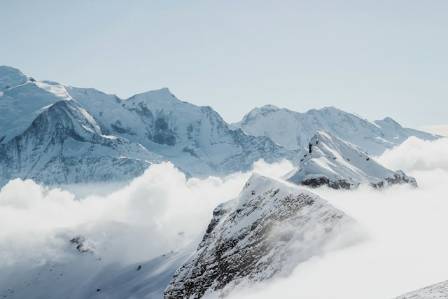
Mount Fuji, Japan
Standing at 3,776 meters (12,389 feet), Mount Fuji is Japan’s highest mountain and one of the country’s most recognizable national symbols. Its nearly symmetrical cone, often covered in snow, has made it one of the most famous mountain silhouettes in the world.
During winter, the snow-covered summit creates a dramatic contrast with the surrounding scenery, especially beneath clear blue skies. Mount Fuji has long held a special place in Japanese culture and has inspired generations of artists, poets, and photographers. Its significance therefore extends beyond its physical beauty, combining a striking natural appearance with deep cultural importance.
Aoraki / Mount Cook, New Zealand
Aoraki / Mount Cook is New Zealand’s tallest mountain, reaching 3,724 meters (12,218 feet). It is located within the Southern Alps and forms part of Aoraki / Mount Cook National Park. During winter, heavy snowfall covers its summit and slopes, creating an especially dramatic alpine scene.
The mountain is surrounded by glaciers, making the area a popular destination for mountaineers, trekkers, and photographers. The snow-covered peaks combined with the turquoise waters associated with the Hooker and Tasman Glaciers add to the remarkable beauty of the landscape.
The Andes, South America
Extending through seven countries across South America, the Andes contain some of the continent’s most impressive snow-covered mountains. Among them is Mount Aconcagua, which rises to 6,959 meters (22,831 feet) and is the highest mountain in the Western Hemisphere.
Aconcagua and many other Andean peaks remain covered in snow throughout the year. Their bright, snow-covered slopes create dramatic contrasts with the dry deserts and greener forested landscapes found in surrounding areas. Vast glaciers and enormous mountain summits contribute to the Andes’ reputation for some of the most spectacular scenery on Earth.
Mont Blanc, France/Italy
Mont Blanc is the highest mountain in the Alps, reaching 4,810 meters (15,781 feet) along the border between France and Italy. Its expansive snowfields and towering glaciers have made it one of Europe’s best-known mountain destinations.
The surrounding landscape becomes especially impressive during winter, when snow covers the valleys, slopes, and nearby peaks, creating an extensive alpine winter scene. From Chamonix in France to the valleys on the Italian side, the snow-covered summit of Mont Blanc serves as a dramatic centerpiece and attracts skiers, hikers, mountaineers, and visitors from across the world.
Mount Kilimanjaro, Tanzania
Mount Kilimanjaro is Africa’s highest mountain, reaching 5,895 meters (19,341 feet). Its location close to the equator makes its snow-covered summit particularly remarkable. The white snow and ice at the top stand in sharp contrast to the warm, tropical landscapes surrounding the mountain.
Kilimanjaro consists of three volcanic cones: Kibo, Mawenzi, and Shira. The snow-covered summit of Kibo can often be seen from considerable distances, producing a striking contrast with the green forests and vegetation found lower down the mountain. Kilimanjaro is a popular trekking destination, and its snowy summit has become a powerful symbol of adventure and natural beauty.
The Swiss Alps, Switzerland
The Swiss Alps are renowned for their snow-covered summits, dramatic valleys, and picturesque alpine settlements. The region contains numerous famous peaks, including the Eiger, Jungfrau, and Matterhorn, many of which remain snow-covered throughout the year.
The mountains provide outstanding opportunities for winter activities such as skiing, snowboarding, and mountaineering. Beyond the peaks themselves, the combination of white-covered mountains, traditional villages, and scenic railway journeys gives the Swiss Alps an especially distinctive character and makes the region one of the most beautiful mountain landscapes in the world.
More from the kitchen

· en
The monarch butterfly: Nature's delicate voyager
Corbin Wells
· en
Roadside Grassland Restoration: Turning Challenges into Opportunities
Emma Brooks
· en
Bay City’s Historic State Theatre Now Up for Sale Amid Bankruptcy and Investigation
Olivia Bennett

· en
8 Elegant Tableware Trends Redefining Upscale Events in 2025
Dean

· en
Exploring Innovative Roof Designs: A Comprehensive Guide
Michael Hughes
· en
Budget-Friendly Beach Vacation Ideas
Elise Warren